Hybrid Work PolicySpace Utilization AnalyticsLEED CertificationFlex Office DemandAI-Powered FacilitiesReturn-to-Office TrendsAcoustic DesignWorkplace WellnessSmart Building TechCorporate Real EstateHybrid Work PolicySpace Utilization AnalyticsLEED CertificationFlex Office DemandAI-Powered FacilitiesReturn-to-Office TrendsAcoustic DesignWorkplace WellnessSmart Building TechCorporate Real Estate
Workplace TechIntelligence Layer Series

Technology
Reshaping the
American Office

From smart building platforms and IoT sensor networks to desk-booking systems and AI-driven facility management, a new generation of workplace technology is fundamentally altering how corporations design, operate, and measure their physical environments.

As AV collaboration infrastructure matures and data-driven space analytics move from pilot to standard practice, triust-onewiev tracks the tools, vendors, and decisions shaping the modern American office — floor by floor.

2,400+

Corporate campuses tracked

$47B

Smart office market by 2027

68{6d0ec87c351fb5baa1e885a9ce525a9c8899e4ed271dcf0df88f3fe259f980a3}

Firms expanding IoT deployments

Technology-enabled open-plan American office

Smart workplace deployment — Chicago, IL · 2024

Live Coverage
Latest Coverage

Workplace Tech: What's Shaping the Industry Now

How Next-Gen PropTech Platforms Are Redefining Corporate Lease Management
PropTech PlatformsJune 12, 2025

How Next-Gen PropTech Platforms Are Redefining Corporate Lease Management

AI-powered lease abstraction and portfolio analytics are eliminating the spreadsheet era for enterprise real estate teams.

DM
Diana Mercer
7 min read
Desk Booking Wars: The Battle for the Hybrid Workforce's Morning Routine
Hybrid Work SoftwareJune 9, 2025

Desk Booking Wars: The Battle for the Hybrid Workforce's Morning Routine

With seven major platforms now competing for enterprise desk reservation contracts, differentiation has moved from features to experience design.

MO
Marcus Oyelaran
5 min read
Demand-Controlled Ventilation Is Finally Delivering on Its Promise — Here's the Data
Smart HVAC ControlsJune 5, 2025

Demand-Controlled Ventilation Is Finally Delivering on Its Promise — Here's the Data

Early adopters of AI-driven HVAC control systems are reporting energy savings of 18–31{6d0ec87c351fb5baa1e885a9ce525a9c8899e4ed271dcf0df88f3fe259f980a3}, with IAQ scores trending upward across the board.

PS
Priya Subramaniam
9 min read
The Connected Office's Blind Spot: Why IoT Device Security Is Still a Critical Vulnerability
CybersecurityJune 2, 2025

The Connected Office's Blind Spot: Why IoT Device Security Is Still a Critical Vulnerability

Smart sensors, HVAC controllers, and access systems now represent a substantial — and largely unpatched — attack surface inside enterprise buildings.

JW
James Whitfield
8 min read
Editorial Explainer

How Smart Buildings Actually Work

A three-part technical briefing on the systems reshaping the American corporate office — from the subfloor to the C-suite dashboard.

01 — Sensor & IoT Infrastructure

The Nervous System of the Modern Office

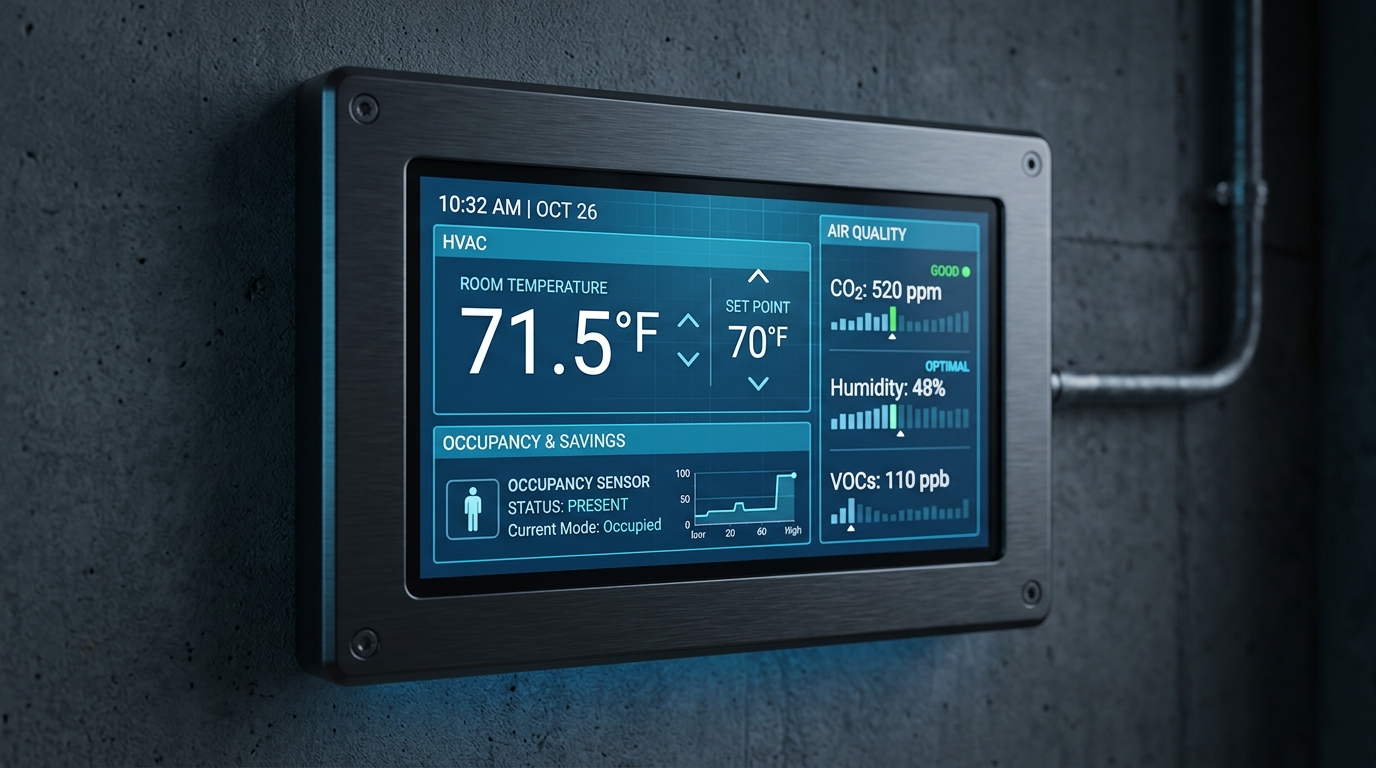
Smart buildings begin with sensors — thousands of them, embedded in ceilings, floors, HVAC vents, elevator shafts, and workstations. These devices collect real-time data on occupancy, air quality, temperature, humidity, light levels, and energy consumption at a granularity that was unimaginable a decade ago. When a conference room sits empty for 40 minutes after a booking, a motion sensor notices. When CO₂ levels creep past 1,000 ppm in an open-plan floor, a sensor flags the ventilation system before any employee feels the cognitive dip. This is not automation in the theatrical sense — it is the quiet, continuous intelligence that keeps a workplace functioning at peak efficiency.

IoT infrastructure in corporate real estate has matured significantly since the early pilot programs of 2015–2018. Today's deployments leverage low-power wide-area networks (LoRaWAN), Bluetooth Low Energy (BLE), and Thread mesh protocols to move data from edge devices to cloud aggregation platforms with latency measured in milliseconds. The critical challenge has shifted from connectivity to data governance: enterprises must now define who owns sensor data, how long it is retained, and how it intersects with employee privacy policies. The organizations getting this right are treating IoT infrastructure not as a facilities expense but as a strategic data asset — one that informs everything from lease renegotiations to mental health programming.


02 — Building Management Systems (BMS)

From Boiler Rooms to Command Centers

Building Management Systems — once the exclusive domain of facilities engineers running proprietary SCADA interfaces in basement control rooms — have undergone a profound reinvention. Today's BMS platforms are cloud-native, API-first, and increasingly powered by machine learning models that predict system failures before they occur. Johnson Controls' Metasys, Siemens Desigo CC, and Honeywell Forge compete in a market that Mordor Intelligence projects will exceed $32 billion globally by 2029, driven in large part by the enterprise mandate to meet net-zero targets by 2030. The boardroom has arrived in the boiler room.

The strategic significance of modern BMS extends well beyond energy management. Integrated platforms now ingest data from access control, fire suppression, elevator management, and parking systems — creating a unified operational picture that allows facilities directors to move from reactive maintenance to predictive asset management. A chiller that runs hotter than its baseline model for three consecutive days will trigger a work order automatically, often before any human notices the anomaly. For portfolios spanning dozens of properties, this predictive layer has reduced unplanned maintenance costs by an average of 22{6d0ec87c351fb5baa1e885a9ce525a9c8899e4ed271dcf0df88f3fe259f980a3}, according to Deloitte's 2024 Smart Building Operations Report. The BMS is no longer a cost center. It is a competitive differentiator.

03 — Employee Experience Platforms

When the Building Learns Who You Are

Employee Experience Platforms represent the consumer-facing summit of the smart building stack. Where BMS and IoT infrastructure operate largely in the background, EX platforms are what employees actually touch — mobile apps, digital room panels, desk reservation interfaces, and visitor management kiosks that mediate the daily relationship between workers and their workplace. The category has attracted significant venture capital since 2019, with players like Robin, Envoy, Condeco, and Freespace competing for enterprise deals alongside Microsoft's Places and emerging features within ServiceNow. The underlying promise is consistent: make the office as responsive to individual needs as a well-managed hotel.

The most sophisticated EX platforms now operate as personalization engines. They learn that a particular executive prefers a south-facing office with standing desk access on Tuesdays, that a given engineering team consistently clusters on the third floor, and that hybrid attendance patterns for a specific department peak on Wednesdays. This behavioral intelligence feeds back into space planning models, giving real estate directors the empirical foundation to make portfolio decisions — how many desks, which amenities, what ratio of collaboration space to focus rooms — with genuine confidence. The risk, as with all personalization at scale, is the blurring of convenience into surveillance. The companies navigating this most successfully are those that have made employee data control a product feature, not an afterthought.

This explainer series is produced by the triust-onewiev editorial team. Coverage is editorially independent.

Browse all topics
triust-onewiev

The intelligence layer for the modern American office — authoritative coverage of workplace technology, corporate real estate, and the future of work.

[email protected]+1 202 555 0194
1201 Connecticut Ave NW,
Washington DC 20036, USA

© 2026 triust-onewiev. All rights reserved.

Washington D.C. — Covering the American workplace since 2019